
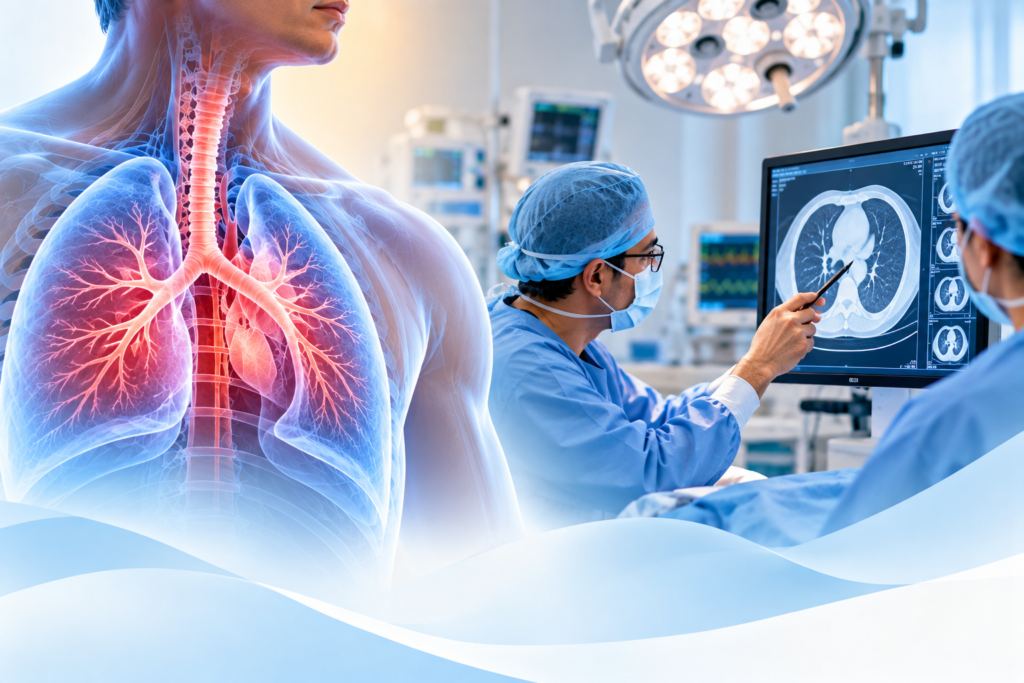
Imagine being told that a problem inside your chest may require surgery. Suddenly, questions begin to arise: Is surgery really necessary? What exactly is wrong? Are there less invasive options? And what should I expect from treatment?
These are natural concerns. The chest houses some of the body’s most vital organs, and any mention of surgery understandably brings anxiety. Whether it is an abnormal scan finding, a persistent breathing issue, or a diagnosed lung condition, understanding which thoracic diseases may need surgical treatment can help you have more informed conversations with your doctor. it explains the conditions that may require surgical evaluation and what treatment options exist for patients seeking the best thoracic surgery in Kolkata.
What Is Thoracic Surgery?
Thoracic surgery is a specialized branch of medicine focused on treating diseases affecting organs inside the chest. This includes the lungs, chest wall, airways, esophagus, mediastinum (the space between the lungs), and diaphragm. Importantly, while the heart is located within the chest, heart surgeries are generally managed under cardiac surgery, which is a related but distinct speciality.
A thoracic surgeon diagnoses and treats conditions affecting these structures through both open and minimally invasive techniques. Treatment decisions are never made in isolation. They are based on a thorough evaluation of imaging studies, biopsy results where relevant, the stage or severity of the disease, your overall health, and a multidisciplinary discussion involving pulmonologists, oncologists, radiologists, and other specialists when needed.
What Conditions May Require Thoracic Surgery?
1. Lung Cancer and Lung Tumors
Lung cancer is one of the most common reasons for thoracic surgical referral. Surgery may be considered depending on the cancer type, stage, location, and your overall health. Procedures can range from a wedge resection (removing a small portion of lung tissue) to a segmentectomy, lobectomy (removing an entire lobe), or, in selected cases, a pneumonectomy (removing an entire lung). A thoracic specialist in Kolkata will always discuss whether surgery is the most appropriate option for your specific situation.
2. Pulmonary Nodules and Lung Masses
A pulmonary nodule is a small, rounded spot found in the lung, often incidentally on a chest X-ray or CT scan. Many nodules are benign, but some may require further investigation through biopsy or surgical removal. When a nodule is suspicious, a thoracic surgeon may recommend surgical excision to obtain a definitive diagnosis or to remove the abnormal tissue entirely.
3. Pneumothorax
A pneumothorax occurs when air leaks into the space between the lung and chest wall, causing the lung to collapse. Symptoms typically include sudden chest pain and breathlessness. While a first episode is often managed with a chest tube, surgery may be recommended for recurrent pneumothorax, persistent air leaks, or cases where the lung fails to re-expand with drainage alone. Surgical treatment usually involves removing the leaking lung tissue and preventing recurrence.
4. Pleural Diseases
The pleura is the thin membrane surrounding the lungs. Conditions such as recurrent pleural effusion, empyema (infected fluid in the pleural space), and pleural thickening may require surgical intervention. For stage II–III empyema, surgical decortication performed via thoracotomy or VATS is often necessary to remove the infected lining and help the trapped lung re-expand. These are serious conditions that benefit from timely evaluation by a chest surgeon in Kolkata.
5. Mediastinal Tumors
The mediastinum is the central compartment of the chest containing the thymus, lymph nodes, and major blood vessels. Tumors or cysts in this area may require surgical evaluation or removal, depending on their type, size, and symptoms. Some mediastinal masses are benign and can be removed safely, while others may require additional treatment such as radiation or chemotherapy after surgery.
6. Esophageal Conditions
Certain esophageal disorders may require surgical treatment. Achalasia, a motility disorder where the lower esophageal sphincter fails to relax, can be treated with surgical myotomy when other approaches are unsuitable. In advanced cases with significant esophageal dilation, esophagectomy may be considered. Treatment depends on the specific diagnosis and severity of your condition.
7. Chest Wall Conditions
Tumors, deformities, injuries, or structural problems affecting the chest wall may sometimes require surgical management. This can include reconstruction after trauma or removal of chest wall tumors.
Symptoms That Should Not Be Ignored
Persistent cough, coughing up blood, unexplained chest pain, breathlessness, recurrent chest infections, difficulty swallowing, unexplained weight loss, or recurrent pneumothorax are symptoms that warrant medical evaluation. These symptoms can have many causes and do not automatically mean surgery is required. However, symptoms such as severe breathing difficulty, significant coughing of blood, sudden severe chest pain, or rapid respiratory deterioration require urgent medical attention.
Thoracic Surgery Treatment Options
Treatment depends on the specific diagnosis, severity, imaging findings, biopsy results, and your overall health. Options include observation and monitoring, medication, diagnostic procedures, minimally invasive thoracic surgery, VATS (Video-Assisted Thoracoscopic Surgery), robotic-assisted thoracic surgery, and open thoracic surgery.
Minimally invasive techniques such as VATS may involve smaller incisions and potentially faster recovery in selected patients. However, suitability for minimally invasive thoracic surgery depends on the condition, its location, and individual anatomy. Not every patient is a candidate, and open surgery remains appropriate for certain cases.
How Are Thoracic Conditions Diagnosed?
Diagnosis typically begins with a medical history, physical examination, chest X-ray, and CT scan. Additional investigations may include PET-CT, MRI, pulmonary function tests, bronchoscopy, biopsy, and pleural fluid analysis. Not every patient requires every test. Your thoracic specialist in Kolkata will recommend the investigations most appropriate for your suspected condition.
When Should You See a Thoracic Surgeon in Kolkata?
Referral to a thoracic surgeon may be appropriate when a suspicious lung mass or nodule is detected, lung cancer has been diagnosed, pneumothorax has recurred, pleural disease persists, a mediastinal mass has been identified, or your pulmonologist recommends surgical evaluation. Seeing a thoracic surgeon does not automatically mean surgery will be performed.
How to Choose a Thoracic Surgeon in Kolkata
When seeking the best thoracic surgery in Kolkata, consider the surgeon’s qualifications and specialist training, experience with your specific condition, access to appropriate diagnostic facilities, availability of multidisciplinary care, hospital infrastructure, and clear communication about diagnosis, treatment options, risks, and alternatives. Do not rely solely on rankings or advertisements; prioritise transparent communication and a patient-centred approach.
Frequently Asked Questions
1. What does a thoracic surgeon treat?
Ans :- A thoracic surgeon treats diseases of the lungs, chest wall, pleura, esophagus, mediastinum, and diaphragm.
2. Does every lung condition require surgery?
Ans :- No. Many lung conditions are managed with medication, monitoring, or other non-surgical treatments. Surgery is considered only when appropriate.
3. What is VATS surgery?
Ans :- VATS is a minimally invasive technique using small incisions and a camera to perform chest surgery, often with less pain and faster recovery in suitable patients.
4. Is thoracic surgery always performed through a large incision?
Ans :- No. Depending on the condition and patient, surgery may be performed through small incisions using minimally invasive techniques.
5. When should I see a thoracic surgeon?
Ans :- When you have a suspicious lung finding, recurrent pneumothorax, persistent pleural disease, a mediastinal mass, or if your doctor recommends surgical evaluation.
Conclusion
Thoracic surgery is used for selected conditions involving the lungs, pleura, esophagus, mediastinum, chest wall, and related structures. Surgery is not automatically required for every thoracic condition. Treatment should be based on proper diagnosis and individual clinical factors. If you have persistent or concerning symptoms, seek appropriate medical evaluation rather than self-diagnosing.
Are You Looking For the Thoracic Surgery in Kolkata : Get a Expert Consultation Today
If you are experiencing persistent chest symptoms or have been diagnosed with a lung or pleural condition, finding the right specialist is crucial. The best thoracic surgery in Kolkata combines advanced techniques with compassionate care. Don’t let uncertainty delay your treatment. Get a best best thoracic surgery in Kolkata today and take control of your health with expert guidance.
Meet Your Cardiologist : Dr Jhulana Kumar Jena

Dr Jhulana Kumar Jena is a highly skilled Cardio-Thoracic and Vascular Surgeon practising in Kolkata, known for his expertise in diagnosing and surgically managing complex heart, lung, and vascular conditions Dr Jena’s clinical expertise covers a broad spectrum of cardiothoracic and vascular conditions. His special interests include coronary artery bypass grafting (CABG), heart valve repair and replacement, aortic aneurysm surgery, congenital heart surgery, and peripheral vascular surgery
Visit Desun Hospital And Get a Professional Consultation For Thoracic Surgery Treatment
Address :- Desun More, 720, Eastern Metropolitan Bypass, Golpark, Sector I, Kasba, Kolkata, West Bengal 700107
Disclaimer :- The information provided in this blog is intended for general educational and informational purposes only. It is not intended to replace professional medical advice, diagnosis, or treatment from a qualified healthcare professional.